Monday, December 13, 2010

future event review lookup

 When:
  Between Friday 03 December and Saturday 18 December from 00.00AM to 00.00AM

Opening Night: 6:30pm Friday 3 December
Exhibition will run until 18 December
Monday – Friday 9:00am – 6:00pm, Saturday 11:00am – 4:00pm

Where:
Pine Street Creative Arts Centre, 64 Pine Street Chippendale 2008 Venue details
Cost: Free
Website:
http://www.cityofsydney.nsw.gov.au/pinestreet/


More Info:
Pine Street Creative Arts Centre
Jane Hooper 9245 1503
jhooper@cityofsydney.nsw.gov.au

Thursday, December 9, 2010

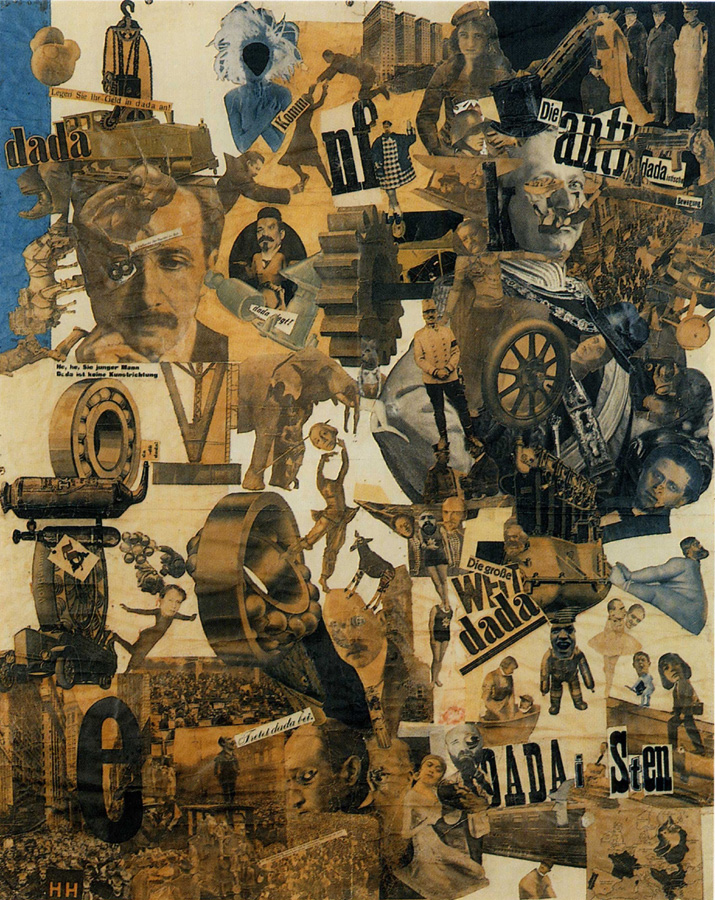
Dadaism, an art movement

"For us, art is not an end in itself ... but it is an opportunity for the true perception and criticism of the times we live in.", Hugo Ball (February 22, 1886 – September 14, 1927)


Hannah Höch, Cut with the Dada Kitchen
Knife through the Last Weimar Beer-Belly Cultural
Epoch in Germany
, 1919, collage of pasted papers, 90x144 cm,
Staatliche Museum, Berlin.
"Dada or Dadaism is a cultural movement that began in Zürich, Switzerland, during World War I and peaked from 1916 to 1922. The movement primarily involved visual arts, literature—poetry, art manifestoes, art theory—theatre, and graphic design, and concentrated its anti-war politics through a rejection of the prevailing standards in art through anti-art  cultural works. Its purpose was to ridicule what its participants considered to be the meaninglessness of the modern world. In addition to being anti-war, dada was also anti-bourgeois and anarchistic in nature." taken from www.wikipedia.org

so basically Dadaism, is an art movement that really into making fun of the modern world, by branding it with "meaningless" tag. Dadaism also an anti-war, anti-bourgeois (social group of people who is considered to be a high class/wealthy and act like it), and anarchistic in nature. this is art movement come during the World War 1, which given us the very basic idea why this art movement were invented back then. The movement was a protest against the bourgeois nationalist and colonialist interests, which many Dadaists believed were the root cause of the war, and against the cultural and intellectual conformity that corresponded to the war.

According to its people who's in Dadaism, Dada was not art, it was "anti-art". Everything for which art stood, Dada is the opposite. Where art was concerned with traditional aesthetics, Dada ignored aesthetics. If art was to appeal to sensibilities, Dada was intended to offend. Through their rejection of traditional culture and aesthetics, the Dadaists hoped to destroy traditional culture and aesthetics.

Hugo Ball, Tristan Tzara, Richard Huelsenbeck, Jean Arp, Marcel Janco, Sophie Täuber, Hans Richter, Emmy Hennings, along with others, discussed art and put on performances in the Cabaret Voltaire In 1916,  Zurich, expressing their disgust with war and the things that inspired it. Some people says that this is the beginning of Dadaism

Thursday, December 2, 2010

Cubism pics

original picture
cubism version


here's my take on Cubism, well I just copy the style and implement it in my picture, nuff said.

Cubism, an art movement

Cubism was a 20th century avant-garde art movement, started by Pablo Picasso and Georges Braque, which  revolutionized European painting and sculpture, and inspired related movements in many different forms of art such as music and literature.

Les Demoiselles d'Avignon 1907
Pablo Picasso
 During the late 19th and early 20th centuries, the European cultural elite were discovering African, Micronesian and Native American art for the first time. Artists such as Paul Gauguin, Henri Matisse, and Pablo Picasso  were intrigued and inspired by the simplicity of styles of those foreign cultures. Around 1906, Picasso met Matisse through Gertrude Stein, at a time when both artists had recently acquired an interest in primitivism, Iberian sculpture, African art and African tribal masks.

They became friendly rivals and competed with each other throughout their careers, perhaps leading to Picasso entering a new period in his work by 1907, marked by the influence of Greek, Iberian and African art. Picasso's paintings of 1907 have been characterized as Protocubism, as notably seen in Les Demoiselles d'Avignon, the antecedent of Cubism.

There are 2 branches of cubism, The first branch of cubism, Analytic Cubism, was both radical and influential as a short but highly significant art movement between 1907 and 1911 in France. In its second phase, Synthetic Cubism, the movement spread and remained vital until around 1919, when the Surrealist movement gained popularity.

Clarinet and Bottle of Rum on a Mantelpiece 1911
-Analytic Cubism-

 In cubist artworks, objects are broken up, analyzed, and re-assembled in an abstracted form—instead of depicting objects from one viewpoint, the artist depicts the subject from a multitude of viewpoints to represent the subject in a greater context. Often the surfaces intersect at seemingly random angles, removing a coherent sense of depth. The background and object planes interpenetrate one another to create the shallow ambiguous space, one of cubism's distinct characteristics.

Monday, November 29, 2010

angles, framing, and gaze

gaze: direct
framing: public
angles: low angle, frontal angle.

in this picture we can see that the represented participant gaze directly at us from above. this picture is showing her power, and authority, and also how we feel some sort of involvement with this picture due to the frontal angle that being used.


gaze: indirect
framing: public
angles: oblique, high angle.

in this picture we can see that the represented participant gaze indirectly at us from below. this picture is showing her lower status and her weakness, and also how we feel uncomfortable with the indirect gaze in this picture. and also the oblique angle makes the some sort of detachment lingering in our mind from this picture, on how different the situation are between the life we have and the life of the represented participant in this picture

Kress & Van Leeuwen - Angles in visual grammar

in today's class, I have to find some information about angles in visual grammar.
here's some information that I got from the book of Kress & Van Leeuwen:

Horizontal angles
These suggest different links of involvement in relationships between the represented person(s) or participants and the viewer.
frontal angle
• frontal angle – suggests viewer involvement with the person or objects in the image
oblique angle


• oblique angle – suggest viewer detachment with the persons or objects in the image (Kress & van Leeuwen 1996)


Vertical Angle
These suggest different links of power relationships between the represented person(s) or participants and the viewer.

high angle
• High angle – the viewer is looking down on the represented person, putting the viewer in a more powerful position


low angle

 • Low angle – the viewer looks up to the represented person, putting the viewer in a less powerful position


eye level
• Eye level – the point of view is one of equality with no power difference involved (Kress & van Leeuwen 1996.)


source:
Kress, Gunther & Leeuwen, Theo Van (1996). Reading Images: The Grammar of Visual Design. London: Routledge.

Thursday, November 25, 2010

Symbolism self made pictures

absolute
for this picture I use the mathematics symbol of absolute and the sun. As the sun is being used by people in the ancient time to represent absolutism.


infinity
for this picture, I use atlas and the ancient Egyptian symbol of infinite. Atlas is a Titan, a race of ancient Gods who comes before the Olympian Gods. In the Mythology, Atlas is being punished by Zeus (Jupiter) to carry the earth for eternity. As for the Egyptian symbol that I used, it's called Shen, or the claw of Horus (the God of Sun) that represent infinity.

blind
For this picture I used different kind of approach. to represent blindness, I used an old children games called: hide and seek. and I blur the picture, to emphasize that the kid don't know where's the location of the other kid.